
 John Jevi dela Cruz
Invoice fraud can turn a normal supplier payment into a serious financial loss. The risk is especially relevant this October because Australia is marking Cyber Security Action Month, and the Australian Signals Directorate has released fresh small-business cyber security guidance.
For accounting teams, bookkeepers and business owners, payment verification is now as important as reconciling the numbers themselves.
Scammers do not always send obviously fake invoices. They may gain access to a real email account, copy a legitimate invoice, change the bank details and continue an existing email conversation.
The payment can look routine until the supplier says the money never arrived.
That makes invoice fraud a finance-process problem as much as a technology problem. Strong passwords matter, but so do clear approval rules, independent checks and disciplined bookkeeping.
Why Invoice Fraud Matters in October 2026
October is Cyber Security Action Month in Australia. The 2026 campaign encourages businesses to turn awareness into practical action.
The timing also matters because many businesses are moving towards the busy end-of-year period. Staff may take leave. Suppliers may push for payment. Accounting teams may be processing more transactions.
Rushed processes can make an unusual bank-detail change or urgent payment request easier to miss.
The Australian Government’s small business cyber security handbook recommends clear processes for validating invoices before payment. It also recommends training staff to recognise business email compromise.
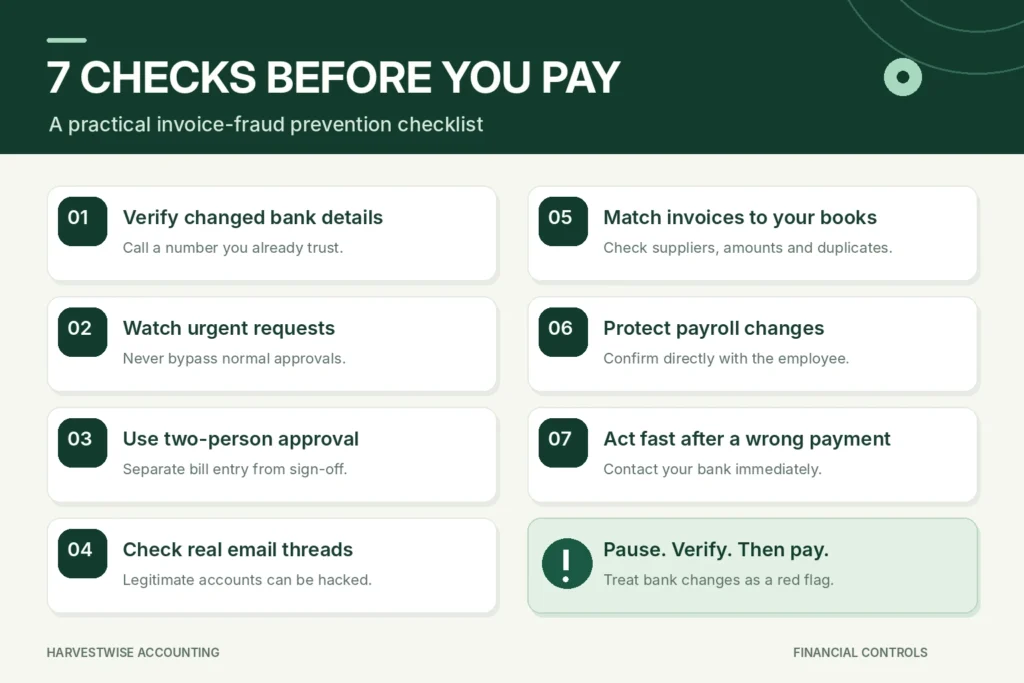
1. Verify Every Bank Detail Change Independently
Never approve changed bank details from email alone.
If a supplier says its banking details have changed, contact the supplier using a phone number you already know or one you source independently.
Do not use the number written in the same email requesting the change.
Scamwatch warns that fake business invoice scams can involve legitimate-looking invoices with altered payment information.
The safest control is a separate verification step before the first payment goes to a new account.
Make this a written rule rather than an informal habit.
It should apply even when the email appears to come from a long-term supplier.
2. Treat Urgent Payment Requests as a Warning Sign
Urgency often pushes staff past normal controls.
A message may claim that:
- payment must happen immediately
- a discount will disappear
- delivery will stop
- a senior manager already approved the transfer
- the request must remain confidential
Pause before acting.
Check the supplier, amount, purchase history and normal approval process.
If the request looks unusual, confirm it through another channel.
A five-minute check can cost far less than trying to recover a payment after the money has gone.
3. Stop Invoice Fraud With Two-Person Approval
Where practical, one person should not control the entire payment process.
For example, one person might enter a supplier bill while another reviews the supporting invoice and authorises payment.
Even a small business can introduce a second review for:
- high-value payments
- new suppliers
- changed bank details
- unusual refunds
- payroll banking changes
This does not require a complicated corporate approval system.
You might simply require another person to confirm any new account details or any payment above a selected threshold.
If your bookkeeping process still relies heavily on manual entry, HarvestWise’s bookkeeping support can help you build a cleaner review process around supplier bills, reconciliations and payment records.
4. Watch for Invoice Fraud Inside Real Email Threads
A convincing scam may not arrive as a brand-new email.
Business email compromise can involve criminals gaining access to a genuine email account and replying inside an existing conversation.
That means the sender name, email history and writing style can all appear legitimate.
The Australian Signals Directorate advises businesses to be cautious about unexpected requests involving payments, changed bank details or sensitive information.
It also recommends multi-factor authentication, strong unique passwords and regular reviews of account activity.
Read the government’s business email compromise guidance if you suspect an email account has been accessed.
5. Catch Invoice Fraud in Your Accounting Records
Invoice fraud becomes easier to identify when your books are current.
Before paying, confirm that the invoice matches:
- a real supplier
- an expected purchase
- an agreed amount
- a genuine purchase order where applicable
- the supplier information already recorded in your accounting system
Check duplicate invoice numbers.
Look for unusual descriptions or amounts.
Compare bank details with earlier invoices where appropriate.
A clean accounts payable ledger can expose anomalies quickly. A messy ledger makes suspicious transactions harder to see.
This is one reason regular accounting work matters beyond tax and BAS.
HarvestWise has previously explained why ongoing accounting support helps businesses identify financial issues earlier instead of discovering them months later.
6. Protect Payroll Changes With the Same Controls
Invoice fraud targets more than suppliers.
Criminals can use a compromised email account to impersonate an employee and request a change to salary bank details.
The request may look routine, particularly when payroll staff receive it close to a pay run.
Use the same independent verification rule.
Confirm bank-detail changes directly with the employee through a trusted channel before updating payroll.
Also restrict who can edit employee banking information.
Review changes before each pay run and keep a record of who approved them.
7. Know What to Do if a Payment Has Already Gone Wrong
Speed matters after a suspected fraudulent transfer.
Contact your bank or financial institution immediately.
Do not wait until the end of the day or the next reconciliation cycle.
You should also:
- secure the affected email or accounting account
- change passwords or other credentials
- review login and access activity
- check whether other payments were altered
- notify affected suppliers or customers where needed
- preserve evidence such as emails and invoices
- report the incident through the appropriate government channels
Scamwatch advises victims of fake invoice scams to contact their financial institution immediately and report the incident.
Build a Simple Payment Verification Checklist
A practical payment checklist can reduce the chance of invoice fraud without slowing every normal transaction.
Before approving payment, ask:
- Is this supplier already known to us?
- Does the amount match the work or goods expected?
- Have the bank details changed?
- If they changed, did we verify them independently?
- Is the request unusually urgent or secretive?
- Does the invoice match our accounting records?
- Does the payment require another approval?
- Are there spelling or email-domain differences?
- Have we checked for duplicate invoices?
- Do we know who authorised the payment?
The goal is not to distrust every invoice.
The goal is to make unusual changes visible before money leaves the business bank account.
Why Good Bookkeeping Helps Prevent Financial Loss
Good bookkeeping keeps records accurate and creates a control system around the business’s money.
Regular reconciliations help identify unusual payments.
Supplier records make account changes easier to track.
Clear approval notes show who authorised a transaction.
Up-to-date accounts also make it easier to notice when a payment does not fit the normal pattern.
This connects directly with cash management. HarvestWise’s guide on managing cash-flow pressure explains why knowing where money is going matters just as much as knowing how much the business earns.
How HarvestWise Accounting Can Help
HarvestWise Accounting can help businesses tighten bookkeeping processes, review supplier records, improve reconciliation routines and create clearer payment approval steps.
If your accounts payable process relies on email, manual entry or one person approving everything, October is a practical time to review those controls before the end-of-year rush.
Contact HarvestWise Accounting to discuss bookkeeping, financial controls or a cleaner month-end process.
Disclaimer
General information only. Cyber security risks and suitable financial controls depend on your business systems, staff and circumstances. Seek appropriate accounting, legal or cyber security advice for your situation.