
 John Jevi dela Cruz
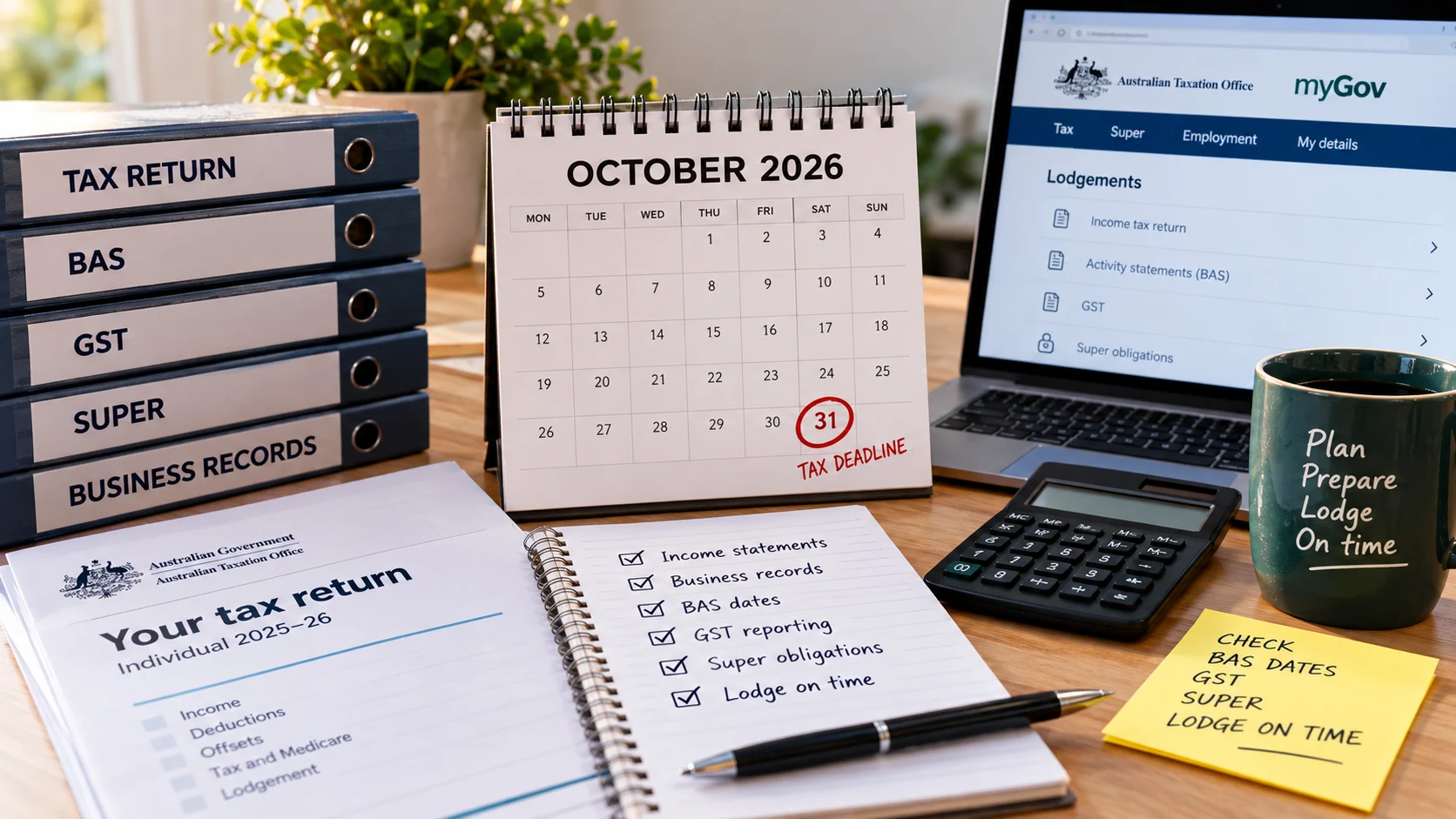
The 31 October tax deadline is getting close, but it does not mean the same thing for every Australian taxpayer.
Individuals lodging their own returns, sole traders, business owners and taxpayers using registered tax agents can all face different rules. Several business obligations also arrive before the end of October.
There is another detail people can easily miss in 2026: 31 October falls on a Saturday. The ATO says that when the normal self-lodgement date falls on a weekend, the deadline moves to the next business day. That generally makes Monday, 2 November 2026 the due date for people lodging their own 2025–26 individual tax returns. Australian Taxation Office
However, not every rule connected with 31 October gets the same treatment.
If you already saw our Tax Return Deadline 2026: What Needs to Be Lodged Now, this guide goes one step further. It focuses on the timing rules that can still catch individuals and businesses out as October approaches.
Why the 31 October Tax Deadline Is Easy to Misunderstand
Many taxpayers see 31 October and think there is one universal tax deadline.
There isn’t.
Around the same period, taxpayers can be dealing with individual tax returns, sole-trader income, monthly BAS, quarterly BAS, annual GST returns, overdue prior-year returns and tax-agent lodgement rules.
The correct date depends on what you need to lodge, how you lodge it and your previous lodgement history.
That distinction matters now because waiting until the final week can leave very little time to identify which obligation actually applies.
1. The 31 October Tax Deadline Moves for Self-Lodgers in 2026
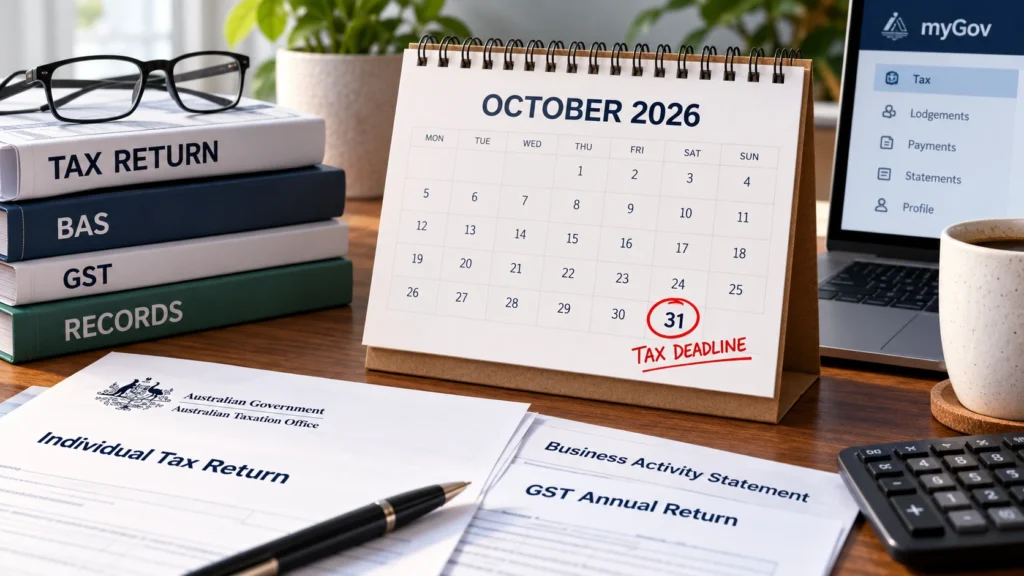
If you prepare and lodge your own individual tax return, the usual deadline is 31 October.
Because 31 October 2026 is a Saturday, the ATO’s next-business-day rule generally moves the self-lodgement deadline to Monday, 2 November 2026. Australian Taxation Office
Sole traders should pay particular attention to this rule.
A sole trader does not lodge a separate business income tax return. Your business income and expenses form part of your individual tax return, so the individual lodgement deadline generally applies when you prepare the return yourself.
The extra weekend does not mean you should wait until November to start.
Missing investment statements, business reconciliations, rental records or capital gains information can still stop you from completing an accurate return.
If you are already checking your return, also review our Tax Return Pre-Fill: 7 Costly Mistakes to Avoid. Pre-filled information can save time, but it still needs to be compared with your own records.
2. Tax Agent Registration Has an Earlier Practical Cut-Off
The weekend extension can create a dangerous assumption.
You may think that because self-lodgers generally have until Monday, 2 November this year, you can also wait until November to appoint an accountant.
The ATO says taxpayers using a registered tax agent for the first time, or changing to a different tax agent, should contact the agent before 31 October to be included in the agent’s lodgement program. Australian Taxation Office
In 2026, 31 October is a Saturday. That makes leaving the engagement until the final weekend particularly risky.
Your accountant may need time to confirm your identity, obtain authority, check your ATO records, identify overdue returns and establish which lodgement date applies to you.
A later tax-agent deadline is also not automatic simply because you contacted an accountant.
The date depends on your circumstances and the lodgement information recorded for you.
If you plan to use a registered tax agent, act well before the end of October.
3. Overdue Returns Can Change Your Current Due Date
This is one of the easiest rules to miss.
If you had one or more prior-year tax returns already overdue at 30 June, the ATO generally gives your current-year return a 31 October due date under the tax-agent lodgement program.
However, there is an important opportunity.
If all those overdue prior-year returns are lodged by 31 October, your current-year return may then receive the appropriate later date under your tax agent’s lodgement program.
Here is the catch: the ATO specifically says overdue prior-year returns cannot use the next-business-day concession for this purpose. They need to be lodged by 31 October if you want the current-year return to move into the agent program. Australian Taxation Office
That distinction is particularly important in 2026.
Your current self-prepared return may generally move to Monday, 2 November because of the weekend. An overdue prior-year return that needs to be cleared for the tax-agent program is a different matter.
If you have an old tax return outstanding, check it now instead of assuming everything can wait until November.
4. BAS Deadlines Arrive Before the 31 October Tax Deadline
Business owners should not become so focused on their income tax return that they miss their activity statement first.
For businesses on monthly reporting, the September activity statement is generally due on 21 October.
For quarterly reporters, the standard July-to-September quarter BAS is generally due on 28 October. Different dates may apply where an eligible registered tax or BAS agent lodges the statement. Australian Taxation Office
That means your BAS can become overdue before the 31 October tax deadline arrives.
A BAS can include GST, PAYG withholding, PAYG instalments and other business tax obligations, depending on your registration.
Do not copy an income tax deadline into your BAS calendar.
If your business regularly gets caught by activity statement dates, review our BAS Due Dates: 7 Risky Errors to Avoid Now. It explains the reporting cycles and common timing mistakes in more detail.
5. Annual GST Can Also Fall Around the 31 October Tax Deadline
Some small businesses do not lodge a monthly or quarterly BAS for GST.
If you voluntarily registered for GST and meet the requirements to report annually, you may instead have an annual GST return.
The ATO states that the standard annual GST lodgement and payment date is 31 October. If you are not required to lodge an income tax return, the annual GST date is generally 28 February instead. Registered tax or BAS agents may also have different dates. Australian Taxation Office
Because the standard 31 October date falls on a Saturday in 2026, the general ATO weekend rule allows lodgement and payment on the next business day. Australian Taxation Office
Annual GST can easily disappear from view because businesses reporting annually do not have the same regular quarterly reminder.
Check your ATO account if you voluntarily registered for GST, elected annual reporting, stopped trading during the year or have not looked at the GST registration recently.
Do not assume your income tax return automatically satisfies a separate annual GST obligation.
6. Not Every Business Uses the Same Lodgement Date
The 31 October tax deadline is especially relevant to individuals preparing their own returns, but business owners can have several entities with completely different dates.
You might personally operate a sole-trader business while also being involved with a company or trust.
Your individual return, company return, trust return and activity statements do not necessarily share one deadline.
Registered tax-agent dates can depend on factors including the type of entity, when the client was added to the agent’s list, whether prior returns are overdue and the taxpayer’s previous lodgement history. The ATO specifically notes that these circumstances can change the due date attached to a client. Australian Taxation Office
This is why copying last year’s date can be risky.
Check each entity separately in the relevant ATO services, or ask your accountant to confirm every outstanding obligation.
7. Lodgement Date and Payment Date Are Not Always the Same
Another common mistake is treating the date you lodge as the date every amount must also be paid.
For BAS, the standard lodgement and payment date will commonly be the same.
Individual income tax can work differently.
For self-lodgers, the ATO states that a tax bill is generally due on 21 November where the return is lodged during the normal self-lodgement period. If the assessment issues after 31 October in the circumstances described by the ATO, a different payment timeframe can apply. The notice of assessment confirms the actual payment date. Australian Taxation Office
The important point is not to delay a tax return simply because you expect to owe money.
A payment problem and a lodgement problem are separate issues.
Lodge the correct return by the applicable date. Then, if payment will be difficult, address the debt or payment arrangement rather than allowing the return itself to become overdue.
Employer Alert: Quarterly Super Dates Have Changed
Business owners with employees also need to remove an old October deadline from their routine.
From 1 July 2026, Payday Super commenced. Employers now generally pay super with each pay cycle instead of waiting for the old quarterly SG dates.
The ATO states that employer super contributions generally need to reach the employee’s super fund within 7 business days after payday under the new system. ATO Software Developers
The final old quarterly contribution covered wages from April to June 2026 and had to reach employees’ funds by 28 July 2026. ATO Community
That means employers should not wait until 28 October 2026 to make one July-to-September quarterly super payment.
If an old payroll checklist still says “September-quarter super — 28 October,” update it.
This is not an income tax lodgement date, but it is an important October compliance change business owners could otherwise miss.
31 October Tax Deadline Action Checklist
Use this checklist before October becomes a last-minute rush:
- Confirm how you will lodge. Decide whether you will prepare the return yourself or use a registered tax agent.
- Contact your agent early. Do not wait for the final weekend if you are a new client or changing agents.
- Check prior years. Identify any overdue income tax returns before 31 October.
- Check your BAS cycle. September monthly BAS generally falls due on 21 October, while the standard September-quarter BAS is generally due on 28 October.
- Check annual GST. Confirm whether an annual GST return appears in your ATO obligations.
- Check every entity separately. Your personal, company and trust dates may differ.
- Separate lodgement from payment. Read the actual due dates shown on your statements and assessments.
- Review your pre-fill. Compare ATO data with your own records before approving the return.
- Update payroll for Payday Super. Do not rely on the former October quarterly SG timetable.
- Request missing records now. Do not wait until the week of the deadline.
What to Gather Before Lodging
Missing documents do not automatically extend the 31 October tax deadline.
Individuals should check that they have complete income statements, bank interest, dividends and managed fund information, rental property records, capital gains information, cryptocurrency transactions, private health insurance details, foreign income and evidence supporting deductions.
Sole traders and business owners should also bring their bookkeeping up to date and reconcile business bank accounts, sales, expenses, assets, loans, GST and payroll information.
Our Tax Records Checklist: 11 Critical Documents You Can’t Miss provides a broader preparation list for individuals and businesses.
If you are relying on pre-filled ATO information, compare it with the original statements and your accounting records rather than accepting every amount automatically. Our tax return pre-fill guide explains the checks to make before lodgement.
Do Not Wait for an ATO Reminder
An ATO reminder does not create a new deadline.
If you already know that a return or activity statement is outstanding, waiting for a reminder can simply reduce the time available to correct the problem.
The safest approach is to check the actual obligations recorded against you or your business now.
That is particularly important where you have changed accountants, missed a prior-year return, stopped operating a business, changed GST reporting cycles or have several entities.
How HarvestWise Accounting Can Help
HarvestWise Accounting can help individuals, sole traders and business owners work out which lodgement dates apply to them before the 31 October tax deadline.
We can review outstanding returns, confirm tax-agent lodgement dates, prepare individual and sole-trader tax returns, reconcile business records, review BAS obligations and identify overdue compliance work.
If your records are incomplete, we can also identify what still needs to be provided before the return is ready.
Explore our tax return services, review our BAS lodgement support, or contact HarvestWise Accounting before the deadline becomes urgent.
The closer it gets to the end of October, the less time there is to resolve overdue returns, missing records and incorrect lodgement dates.
General information only. Lodgement and payment dates depend on your circumstances and the obligations recorded by the ATO. Speak with a registered tax professional for advice relevant to your situation.